Showing posts with label Space. Show all posts

Thursday, 2 August 2018

Portiuncula: For the Feast of St. Mary of the Angels


Portiuncula

All quiet he came, barefoot,
and brown as the leaves that
fell at his feet like blessings.
A wanderer in the woods;
this day, he had woken weary
and in his sitting stillness
felt the call to journey
further into wonder.
He had followed the bird songs
and slanted sun beams as signs,
listening with love to the lay
that seemed always to sing out
from every stone and leaf,
from every bird and beast,
calling him along the way,
until at last, and suddenly,
he stepped into that clearing
and saw so bright
in sudden Sun's appearing
the grey green mossy walls,
the tumbled stone,
the ruined chapel,
long forgotten by all
but Angels and Animals,
who often find in our withdrawal
a safer sanctuary
to keep their innocent vigil,
and psalm together in a harmony
our sin discordant voices can
no longer sing.
He stood there a moment,
as still as one who sees beyond
and knows himself a servant
of the flame that burns the bush
but consumes it not;
slowly understanding his draw to this place
within the deeper call, echoing resounding
once more in soul's song:
to rebuild the ruins,
firm the foundations,
and raise the roof of grace.
Kneeling now, he gently bows
and touches his forehead to the ground,
the holy cross is graven once again
upon his heart, and then he reaches
for a stone, long fallen from its place,
and kissing it with reverence for the gift
of the Mother it makes of itself,
he places it upon another,
and begins again to build the church of God.
That night, as lady Moon
crowned the new set stones with silver,
he lit the long dark lamps
before the face of one his heart
called Queen and Mother both,
and realised with joy
to whom this holy place belonged.
Standing he sings alone his nightly songs:
psalms, and hymns, and lovers lauds
to the Lady of his soul and then he sleeps,
this troubadour in his tumbledown temple.
Until in deepest dark he wakes with wonder
to find a new light all about him,
fairer than moonlight, gentler than stars,
emerging from these old sacred stones,
as all around the gathered sit
in serried rank, birds and beasts alike,
all watching for their
Lady's smile upon her lately sleeping servant.
Now roused he hears the heralds of heaven
sing their own music, alike to his
but deeper, greater, older, sweeter,
lifting his troubadour tunes
into the great song of heaven's hearing.
Lost in love and light he listens,
caught up in creation's hymn,
whose crowning Queen he knows
here now in her sanctuary by sight,
and sits where he,
her knight errant of the road,
had lately slept his labours off.
The music, never silenced, fades, a little,
and beckoning him to her side
she whispers words of such blessing
he cannot believe;
to his care this place is given,
his little portion it will be,
and to his brothers yet to come
also a reminder, an anchor
a place of refuge and renewal,
of beginning blessing,
and the promise of an ending
in the embrace of she who gathers
these poor scared sparrows
neath her mother's mantle
to gift them to her Son.
Then reaching forth,
the Lady touched his tired eyes,
and seeing now with heaven's gaze,
the ages fall about him
telling the tale of all the Friars who follow;
the Sisters too, will have here their birth beginning,
until an even greater forest grows
about this blessed place, planted in peace
and bearing joy as fruit,
born from the seed of Gospeled faith,
sheltering with blessed branch all beings
who seek the shade of pardon and long for peace.
He weeps then, this rebuilder of blessing,
long and loud is his lament,
his mourning for the early days misspent,
 declaring his deeds, he seeks
her departure from one so stained,
yet she, the Lady, smiles all the more,
lifts him up, calls him son,
as much her building
as the stony walls about them both.
Then with a swell of Angel song she leaves,
or at least is seen no more,
and the little brother
does the only thing he can,
as, with makeshift trowel in hand,
and weeping still,
he picks up another stone
from off the floor.


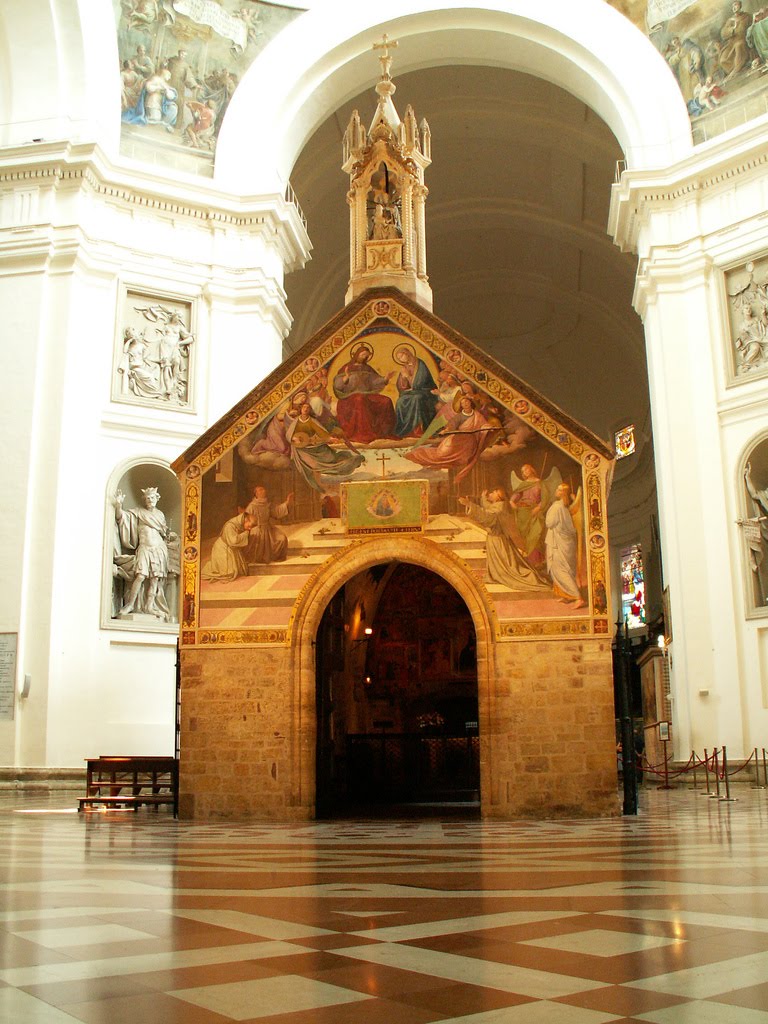
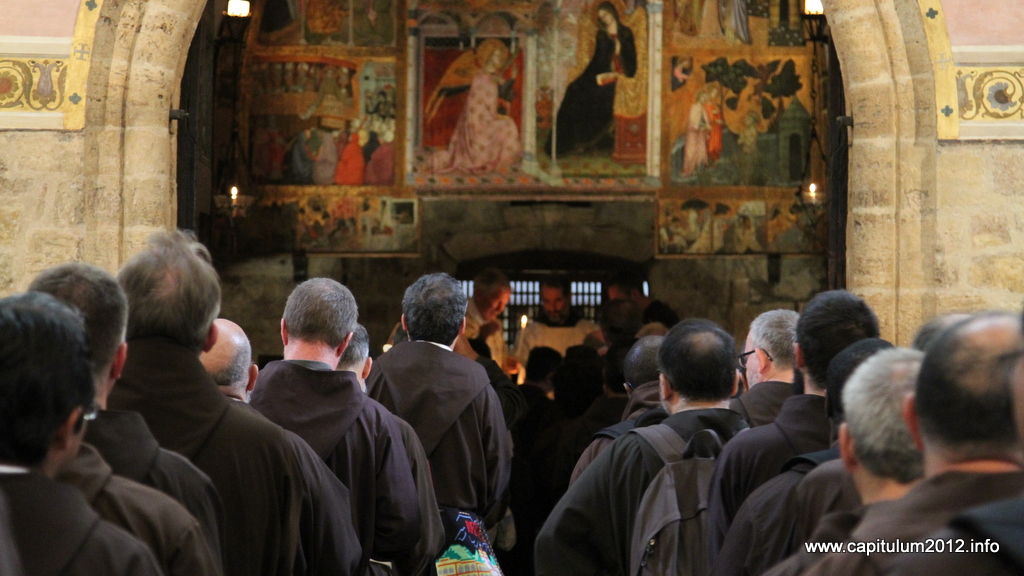
Today is the feast of Our Lady of the Angels of the Portiuncula, a foundational feast for all Franciscans throughout the world. It was at the little forest chapel, rebuilt with his own hands, that Francis founded the Order, dedicating it to Our Lady of the Angels, there he received the vows of the brothers and of St. Clare, spent much time in meditation and finally breathed out his soul to God... The little chapel remains the heart place of the Franciscan soul and is a place of blessing to this day.


The "pardon of Assisi" the plenary indulgence granted to St. Francis to honour this feast and title of Our Lady may be obtained by visiting any public church until midnight tonight, praying the Creed and the Our Father for the intentions of the Pope and receiving Sacramental Confession and Holy Communion within 7 days before or after the feast.

Monday, 18 December 2017

O Adonai! A meditation on the second of the Great O Antiphons of Advent


O Adonai!
We cry to you across the endless ages!
We call you by the name for the Name,
that only the One beyond all names may bear, O Hashem!
We seek from you our own exodus
from the cold and hard world
we have built within ourselves,
and hurt so many others by.

O Adonai!
We yearn for your deliverance!
Free us from the slavery to that false self
that is but a shadow of our souls
Let us put off the sandals that insulate us
from the deep throbbing heart of Mother Earth
and step into your Holy Presence
which is everywhere,
and there,
bow down before
the wonder of it all.
O Adonai!
Send to us the Angel of the Burning Bush!
May he call out to us,
so lost in our own thoughts
and worries
and dreams
that we may
at last
remember
the holiness of the ground
we stand on in every place
and at every time
for our where and when
rests always in
your divine
Now.
O Adonai!
Draw us to yourself, O Holy One!
Lead us on that pilgrim path
from the depths of our selfishness
to the heights of the mountain of compassion
and emptiness.
Bid us enter into the cloud,
that dissembles thought
and pierces the proud heart
so to open the soul to the
truest of loves.
O Adonai!
Let us hear the thunder in the void!
There at the summit and centre of our souls
inscribe your new Law of Love
upon the tablets of our hearts
in letters of divine fire!
O Adonai!
At hour of sunset
and star rise we call to you!
Hear the chant of your Church,
echoing the long and faithful love
of Abraham, and Isaac and their storied
generations.
Listen to these ancient invocations!
Look not on us,
nor on our readiness,
Look instead on she who is,
the Lady of Israel,
the Daughter of Zion,
the Queen of Heaven!
She who is
our burning bush ,
always aflame
but ever unconsumed,
who holds within her
sacred womb the mystery
of the Name made flesh!
Hear us sing her new song of deliverance
Hear the mystery magnified in woman
who in that holiest of births
brings about
our deliverer,
and invites
our exodus
home.
O Adonai!
"Magnificat anima mea Dominum!"
We cry with her,
and in her holy
burning words
we hear the song of her people,
our ancestors of spirit,
echoed anew:
"Ashira L’Adonai ki ga’oh ga’ah!"
And so we sing
with all the generations
this Advent night!
"O Adonai,
and leader of the House of Israel,
who appeared to Moses
in the fire of the burning bush
and gave him the law on Sinai:
Come and redeem us
with an outstretched arm!"

Monday, 6 November 2017

Celtic Christianity: a brief essay


Celtic Christianity:


For the Feast of the All Saints of Ireland here is an essay on Celtic Christianity!
I was invited to write this by Sr. Stan Kennedy for inclusion in her 2015 Book: To Live from the Heart.


Celtic Christianity

The interplay of culture and faith has always produced unique ways of being Christian,
(or Buddhist, or Hindu, or Muslim), When a faith encounters a new culture there are two possibilities – domination, which leads to resistance, fear or even violence; or fusion, which leads to a comfortable inter-being in which the best of what was is nourished by the best of what is. In the Christian tradition, this second way of being has over the centuries led to the beauty of the various Rites of the Church. Each is distinct in language, history and ritual yet all are one Church in confessing one Lord, one faith, one baptism. Unity in diversity is the very mark of the Church in its
catholicity, in its universality.

In the faith communities that grew up in Europe at its westernmost edge between the fourth and tenth centuries this accommodation to native culture, and yet illumination and completion of it by the Christian message, was undertaken in a way never seen before in the history of the Church. A faith community emerged, which though seeing itself as part of the larger Christian Church nevertheless had a unique way of being and a distinctive vision of itself, of the world and of God; a vision that is characterized today as ‘Celtic’. Much of this has been lost in successive waves of invasion and ideology but the traces that remain whisper to the sacred places in many people’s hearts and offer a glimpse of a way of relating to faith and to the Church that seems to ground them in this world and the next in a way both fully human and fully in communion with creation.

The ‘Celtic Christians’ in essence inherited an older form of Christianity from the deserts of Egypt, Lebanon, Syria and perhaps even as far away as Ethiopia. Theirs was a monastic Church, founded by monk missionaries who carried the disciplines and teachings of a contemplative form of life that both completed and transformed beautifully the ‘pagan’ understandings of the pre-Christian Celts. Perhaps it was this origin in a monastic and contemplative way of being that led to the ready fusion of old and new, for the Christianization of the Celtic tribes and lands, particularly Ireland,
happened quickly, and largely without violence or persecution.

To a people who worshipped a pantheon of deities and saw the presence of the divine in every aspect of nature, the revelation of Christ and the Trinity offered a Hero and a High King as well as a God who was, at one and the same time, utterly transcendent of and gloriously immanent in his creation, so it took little to bring the pantheistic pre-Christian Celts to a more subtle understanding of a pan-en-theistic faith, especially when the transition nourished their longing and hope for an afterlife that could be gained without the sacrifice of lives in war, one open to all genders and classes of people regardless of their rank or tribe. Awareness of the presence of the divine in and through the beauty of nature is a mark of this particular expression of Christianity: to such adegree that whilst it is present, and always has been, in the Judaeo-Christian tradition, it had never been so poetically and beautifully expressed before, and would not be again until the Franciscan School in the 1200's.


So what were these ways of being Christian that were manifested in such a unique way in the Celtic forms of Christianity? The early Celtic Church often built on the foundations of monastic communities, each led by an elder known for their holiness and wisdom. The parallel of this structure to the tribal/clan system of the indigenous peoples under a chief meant that there was an immediate understanding, as the two systems seemed to share a common way of life despite their different origins. Loyalty to Clan and to Chief and through him to the High King beautifully paralleled the monks’ obedience to the Elder and above all to Christ, the High King of High Kings. A people raised on the sagas of the Fianna and the Red Branch Knights saw the sacrifice of one’s life to an ideal, and especially to the service of a king, as noble and to be admired. Leaving home and family to serve the Gospel became attractive, even to those of royal and noble blood. This can be seen in the stories of
Colm Cille (Columba) and Brigid. The so-called ‘green martyrdom’ of trusting in the providence of God called forth great missionaries like Brendan and Columbanus, who brought the Celtic expression of the Christian faith to parts of northern Europe and perhaps, in the case of Brendan, a good deal further! Rowing out from land into the ocean currents, they simply went wherever wind and wave, fellow servants of the High King of Heaven, brought them and there lived their life of prayer and praise.

Despite the lush greenness of much of the Celtic territories the spirituality of their monastics was influenced greatly by the fathers and mothers of Christian monasticism who had flourished in the deserts of Egypt and the Lebanon; large monastic complexes – often called ‘Disearts’ for the perceived extremity of the observance – often vied with each other in their pride in the monks and nuns who fasted the most or kept the most vigils, or whose elders worked the most miracles. This ‘boasting in God’ was not meant as a source of vainglory or pride: it came from the bardic culture that esteemed its heroes and heroines and commemorated their deeds to inspire the spiritual practice of others. The bardic culture of long epic poems and sagas created an educated class who,
along with the druids, were among the first Christian converts; they aided in the exchange of ideas, links between cultures and cultivation of wisdom that led to the Celtic monasteries’ reputation as bastions of learning and contemplative practice when the rest of Europe was falling into the chaos of the so-called “Dark Ages”. In Celtic monasticism the fusion of desert spirituality with a holistic understanding of creation and humanity’s place in it saw redemption as bringing
about such a healing of the person that a new and holy unity with creation was the result. Through the ancient remedies of prayer, meditation, fasting, vigils and charity, the monastic began to experience that oneness with nature that Adamic humanity first knew. We have many stories of the Celtic saints and their animal companions: Kevin and the otter, Colm Cille and his horse, Gobnait and her bees, among so many others, show a marvellous intimacy with our fellow creatures in which we all serve the Lord of Creation according to our capacity and gifts.

The visible creation can be a door to the unseen world too. For the Celts, a liminal and animistic people, the nearness of the supernatural, the world of angels, demons and elemental powers carried over from pre-Christian days, was actively completed by the sacramental view of nature that is at the very heart of the Christian contemplative tradition in which all that exists is a word from the Word of God, and creation itself the universal testament to all peoples of all times of Divine Beauty and its nearness to us in every breath.

In the Celtic, domestic form of spirituality every household act, no matter how small, could be performed mindfully in the presence of the divine and
thus assume a cosmological and redemptive purpose and meaning. The blessing prayers and poems that come down to us from places like Donegal and Kerry
and especially from the Hebrides hold an immense lexicon of benedictions for every activity and task of the day and important moment in life. The making of bread, the laying of the fire, the opening of the hall door, the kindling of the evening lights all had their blessing prayer and ritual (usually performed by women in the home and by men on the land), and each had its patron saint or angel. The domestic scene, an expression of the Church in its own right, mirrored and deepened the life of the larger Church, nurturing the sense of belonging and being part of the redemptive mission of Christ through his Church.


With the turning of the year the old festivals found their fulfilment in the liturgical calendar. For example, the honouring of the ancestors at Samhain has its counterpart in the feasts of All Souls and All Saints in which the ancestors were no longer to be feared or placated but to be assisted by the prayers of the living. The old grave offerings became the blessed salt and bread left in the hearth overnight and consumed the next day. The Fires of Lughnasa became the bonfires of St John’s Eve and the dancing around them continued, as did pilgrimages to holy wells and trees and mountains, places now sanctified by the observances of the saints and the miracles they wrought. “Cuimhnionn an tir na Manach,” the people would say ever after: “the land remembers the monks”. So the people would gather to celebrate the goings in and goings out of life; the births, the marriages and the deaths, sanctifying them by their association with the saints of old in ruins and caves
soaked in centuries of prayer.

Today, this unique spirituality and way of being Christian appeals to a generation that achingly feels its distance from the earth and her seasons, that is stressed and distressed by the pace of life and by separation from its inner rhythms. In the wave of mindfulness and meditation programmes and classes that has swept across the Western world we can detect a hunger for the wisdom of the old ways and old paths. Perhaps we need to return to the pace of the ancestors who lived with a foot in both worlds, and in domestic familiar intimacy with God; to return to a pace slow enough for us to discern the language of praise and beauty that issues from every tree and rock and rivulet of water, to realign humanity with its ancient purpose and meaning as the Celtic Christian understood it.

It would be no small thing if this wisdom was recovered and renewed for the next generation. A humble affinity with nature and a sense of our place in the cosmic context of creation and redemption would allow us to recover ourselves as pilgrims
passing reverently through this world with one eye always on eternity and a heart and soul on fire for the High King of Heaven who blesses every place, every moment and every breath.

Friday, 5 February 2016

Thoughts for a Friday

Thoughts for a Friday:

If you're running to do,
while forgetting to be,
let your doing be being
by being your breathing;
with fullness of mind
not leaving behind
the person you are
in a moment so far
from the real and the now;
lest forgetting quite how
you'd ever get back
to a mind that's on track
and be able to deal
with all that could steal
your peace and your grace
and the light from your face!
So why not breathe deep?
Into now you will leap
and there be quite free
to do and to be,
in one unified whole
that we call the soul,
and from there take flight
to a place of clear light
with no strain and no stress,
no fear and no mess,
but a present that's wide
as the sea at full tide,
from where you'll begin
to let peace back in
and then you will find
your true and clear mind,
always stable and right
in the One who is Light.


Monday, 1 February 2016

A litany of St. Brigid of Ireland


Today is Lá Fheile Bhríde, St. Brigid's Day! It is a solemn feastday here in Ireland as we commemorate the great Brigid of Kildare, Abbess, eldress, healer, wonderworker and patron of Ireland. Traditionally today was seen as the first day of Spring here in Ireland and the work of the year ahead both on the land and in the home was placed under the patronage of St. Brigid... 
Litanies both old and new are wonderful ways of meditating on the life and witness of the saints may this litany bless you and yours this St. Brigid's day.


Brigid of the hearth and the hare
Brigid of the spark and the flame
Brigid of the cloak and the veil
Brigid of the herb and the stars
Brigid of the byre and the kine
Brigid of the ill and the old
Brigid of the young and the wild
Brigid of the poor and the voiceless
Brigid of the oak and the staff
Brigid of the long nights watching
Brigid of the sun’s slow dawning
Brigid of the moon’s spring rising
Brigid of the first bloom’s flowering
Brigid of the well’s gentle healing
Brigid of the Earth’s old wisdom
Brigid of the Nun’s deep chanting
Brigid of the High King of Heaven
Brigid of the rush woven cross
Brigid of the shaven head
Brigid of the lost sword
Brigid of the royal house
Brigid Abbess of the duel house of prayer
Brigid Eldress of the sanctuary’s light
Brigid Wise Woman of the healing touch
Brigid saint of Ireland
Pray for us

Thursday, 10 December 2015

Dealing with those Distractions: The Meditation Gym.

Dealing with those Distractions: The Meditation Gym.


There is a wonderful story from the life of that great mystic and master of meditation, St. Teresa of Avila, that deals with distractions in prayer beautifully.
Having been brought to a convent of sisters to teach them about the way of meditation she did so in great depth and with much skill. However, towards the end of her time with them she was asked by one of the sisters to describe how she herself meditated. Taking the last half hour that the sisters had gathered she began by saying she had gone to the chapel with them, genuflected before the Lord in the Blessed Sacrament, and interiorly dedicated the time of prayer to Him. Then she sat in stillness, and almost immediately was distracted by a sunbeam illuminating the corner of the chapel that showed up a little dust. She began to think to herself that the sister in charge of the sweeping wasn’t doing a very good job…
But she remembered she was there to pray and returned to her meditation…
A few moments passed and then she noticed that the sister kneeling in front of her had three nails in the sole of one sandal, but four in the other…
Where could the other one have gone to, she wondered…
Was it a case of two few nails in one or too many in the other?...  
But she remembered she was there to pray and returned to her meditation…
A few moments passed, and then she noticed that the breathing of the sister beside her was in a different rhythm to her own and she began to listen to the music of her breath…
But she remembered she was there to pray and returned to her meditation…
St. Teresa continued to describe the ongoing oscillation from distraction to distraction that to her listeners seemed to comprise the whole of her meditation much to the dismay of the sisters who wanted to learn from this Master of Prayer.
At the end one of them was so amazed she blurted out, “But then you were just distracted for the whole of your meditation!”
“Ah,” said Teresa, smiling, “Yes, I was distracted but I returned each time and that makes all the difference.”

Perhaps one of the most common difficulties in prayer that is brought to me both as a teacher and as a confessor is the whole area of distractions during meditation.  

People can often torture themselves over this perceived difficulty, indeed, for some the encounter with the dross and ephemera that arises before the mind’s eye during meditation can be so off-putting and the struggle to defeat them become so exhausting that it can even be enough to put them off the practice of meditation completely… in a later post we will deal with the content of these thoughts and the wisdom of the fathers and mothers as to how to deal with the major ones that every meditator has to struggle with, but for today let’s look at the general problem of distractions and how we should deal with them in meditation…

You see, the problem often begins with dividing our assessment of our period of meditation into the time “I was distracted”, (which often seems like the majority of our time), and “the time I was meditating”, (which usually seems like the minority), when the real issue is that we are approaching it from the wrong perspective by using this as the framework of our division of the time in the first place. The problem then becomes further compounded when we add a layer of guilt and self-recrimination for the distractions in to the mix. This then arouses anxiety and further separates us from the relaxed stillness necessary to our prayer. These difficulties arise when we fail to realise that the distractions are a part, indeed a very necessary part, of the meditative process. I will repeat that: The distractions are part of the discipline of prayer.

Let me explain…

Suppose as part of your “New Year, New You” initiative, (that takes place every January first), you decided you wanted to build up your biceps, or triceps, or abs or whatever muscle group you feel needs some work. You go to the gym and with effort you lift a weight. (So far so good.) But then you NEVER put it down again. Do you build the muscle? No of course not, in fact you will probably wither it and end up with less movement and less muscle. It is in both the contraction and the release, the picking up of the weight and the putting it down again, that the strength of the muscle is built when the process is repeated over and over again. The same is true for the mind at prayer. Every time a distraction arises, and we notice we are distracted, we simply and gently return to the anchors of the breath and the Prayer Word that draws us back to our focused mindful awareness of the Divine Presence. The taking up of the time of prayer is the picking up of the weight. The distraction arising is the releasing of the weight. As long as we pick up the weight again as soon as we notice that we have put it down, we are only building the “muscle” of the attention, refining our mindful awareness a little more each time, so that over the days, weeks, months and years of practice we will find that the distractions become less and the periods between them become longer. Indeed, after a time the distractions will simply rise and fall but our own focus on the Presence will remain true beneath and beyond them.

This “discipline of distraction” is actually essential to the beginner in meditative prayer and is the whole of the art in its initial stages. It refines focus, builds attention in a gentle way, opens the present moment as the place of encounter with the Divine Presence, and deepens our humility and the awareness of our need for Divine Grace.
In coming back again, and again, and again, we are allowing the Holy Spirit to write the path of metanoia, the path of conversion, (literally re-turning to God) within our hearts. It is on and in this struggle (parrhesia) for mindful attention that the Desert Fathers and Mothers saw the foundations of the real meditative life being built, and it was the art that the monastic had to be grounded in before moving on to deeper forms of meditative prayer.

As the great master of prayer St. Francis DeSales wrote in his wonderful treatise The Introduction to the Devout Life,

“If the heart wanders or is distracted, bring it back to the point quite gently and replace it tenderly in its Master’s presence. And even if you did nothing during the whole hour, (of meditation), but bring your heart back and place it in Our Lord’s presence, though it went away every time you brought it back, your hour would be very well employed.” 

 So then, the next time you go to sit... and the distractions arise... smile... once you have noticed them... and then immediately return to the breath and begin again...and again... and again... this is the discipline of meditation, this is the path of prayer... this is the way to build mindful attention of the Divine Presence... And as you leave your meditation, if anyone asks you what you were doing in there just say "Working out!"

Blessings :)

Monday, 23 November 2015

Becoming Present: The Mindfully Meditative Way of Prayer


The Mindful Meditative Way...

Mindfulness is the buzzword of the moment. It seems to be everywhere. 
From psychology to education, from psychotherapy to the worlds of business and management, the “mindful way of doing things” is the prescribed way of achieving success and the conduit by which all of these disparate disciplines hope to move to the next level. This current wave of mindfulness arises primarily from the work of Dr. John Kabat-Zinn an american professor who, with his book, “Full Catastrophe Living”, (which itself arose after his own experience of the usefulness to himself and his clients of a series of exercises proposed by the Buddhist Monk and Zen Master Thich Nhat Hanh at a retreat he attended), opened up the practice of Mindfulness for the twentieth century. At a time when humanity seems to be mindless in so many of the directions it is taking Mindfulness, as proposed by Kabat-Zinn and many others like him, has offered a way of becoming present to ourselves, to each other and to the transcendent dimension of life in a way that is accessible to everyone. However, sometimes this way of presenting mindfulness has led to a false belief that the discipline is one that is only found in the eastern traditions. In fact, all religions and cultures have taught that the mindful state is the prerequisite for beginning the meditative path, and this includes our own Judeo-Christian tradition.

Since Old Testament times Mindfulness, “Kavannah” in Hebrew, has been taught as an essential practice on the way of prayer. The revelation of the Divine Name to Moses as he encounters the burning bush invites the chosen people into a unique awareness of God as the “I AM”, literally the only One who is truly present, who truly IS and whose presence is accessed through deepening our awareness of His presence in every succeeding present moment. The ancient Jews taught that unless the law, “the Torah”, was observed with Kavannah, with mindfulness, then it could not be said to be observed truly. Jesus Himself teaches the disciples to dwell in the present moment, having no care for tomorrow but trusting in the loving providence of the Father. In teaching them of prayer He insists they must enter the inner room of their heart and there encounter the presence of the Father who is already there, present and waiting for us in the present moment. In speaking of the Holy Spirit, the life of God within them, Jesus teaches them to perceive the presence of the Spirit as the breath of life, (pneuma), and after His resurrection breathes the Holy Spirit over them. The ancient fathers of the Church such as St.’s John Climacus, John Cassian, Benedict, Gregory Nazianzus, and all those coming from the desert monastic tradition, continually returned to these ideas and spoke of the necessity of developing the “art of attending to the present moment”, being mindfully aware, (prosekai), as the essential art of the man or woman who prays, and they developed many techniques for centering the mind in the heart through the use of the breath and the “prayer word”, (versiculum), so as to remain in this inner watchfulness in which the love of God may be truly encountered and then yielded to in such a way as to allow the Holy Spirit to begin His healing work of sanctification.


Over the succeeding centuries many of the saints, mystics and great teachers of prayer have even spoken of the present moment as a “Sacramental Space” in which, if we deepen our attention fully enough, become mindful enough, we will be able to discern the presence of God inviting us into contemplation and then hear the voice of God inviting us into mission. In modern times saints and teachers such as St. Therese of Lisieux, Dom John Main, Thomas Merton, Abbot Thomas Keating, and Pope St. John Paul II have all insisted that this contemplative, mindful dimension of Christianity must be taught once again as the birthright of all the baptised and so have preached and taught its ancient way of practicing the presence of God. Practices as seemingly diverse as Lectio Divina, Centering Prayer, the Practice of the Presence of God, the Rosary, the Divine Mercy Chaplet, the Jesus Prayer, Eucharistic Adoration, are all instruments that, when prayed mindfully, with the attention of the heart, may become ways by which Divine Grace can lead us into the encounter with that deep stillness and silence that exists behind the noise of our distracting thoughts and allows us to “Be Still and Know that I am God.” (Ps:46) 

We can, therefore, safely say that the practice of Mindfulness Meditation, centred on Christ, has always been a part of our prayer tradition and we must give thanks that the modern wave of Mindfulness has woken us up to the ever ancient, ever new contemplative path that is distinctively our own as Christians, while also allowing us a space in which to dialogue with our brothers and sisters of other traditions and learn from them as they learn from us. The mindful, meditative path is the path of every Christian and indeed of every human being, and a universal invitation to know the God who IS and whose “ISness of Love” is revealed in the precious present moment.

As one of our own saintly brothers, Venerable Solanus Casey always taught, “All that God asks of humanity is that they be faithful to the present moment.” 

Blessings to you in this present moment...

Sunday, 2 August 2015

St. Mary of the Angels: The Portiuncula

Today, (August 2nd), we in the Franciscan Family keep the Feast of Our Lady of the Angels!

This is the patronal title of the Blessed Virgin under which St. Francis placed the Order. St. Francis had great devotion to Our Lady under this title due to his repairing of the little chapel of the "Portiuncula" (little portion) in the woods outside Assisi and becoming devoted to it as a place of prayer and meditation in which the earliest brothers gathered and St. Clare was first received into her vows, where St. Francis had a number of visions on Our Lady and the Angels and received the famous privilege of the "Pardon of Assisi" from the Pope, (a plenary indulgence that anyone may receive under the usual conditions in any church throughout the world in honour of Our Lady of the Angels.)
Finally, it was at the Portiuncula also that Francis greeted Sister Death and passed to the Lord in the year 1226.
Assisi_Portiuncula-Our Lady of the Angels
Today the little chapel still exists now surrounded and protected by a great Basilica where pilgrims gather to this day...
Some prayers in honour of Our Lady by St. Francis follow so you can pray with us today.
Hail, Lady and Queen,
holy Mary, Mother of God,
Virgin who became the Church,
chosen by the Father in heaven,
consecrated by his beloved Son
and his Spirit, the Comforter:
in you was and remains,
the whole fullness of grace
and everything that is good.
Hail, his palace,
hail, his tabernacle,
hail, his dwelling,
hail, his robe,
hail, his handmaid,
hail, his mother!

O holy Mother,
sweet and fair to see,
for us beseech the King,
your dearest Son,
our Lord Jesus Christ,
to death for us delivered:
that in his pitying clemency,
and by virtue of his most holy incarnation
and bitter death,
he may pardon our sins.

Holy Virgin Mary,
among all the women of the world,
there is none like you.
You are the daughter and handmaid of the most high King,
Father of heaven.
You are the mother of our most holy Lord Jesus Christ.
You are the bride of the Holy Spirit.
Pray for us, with St. Michael the archangel,
and all the powers of heaven
and all the saints,
to your most holy and beloved Son,
our Lord and Master, Amen.
Portiuncula3